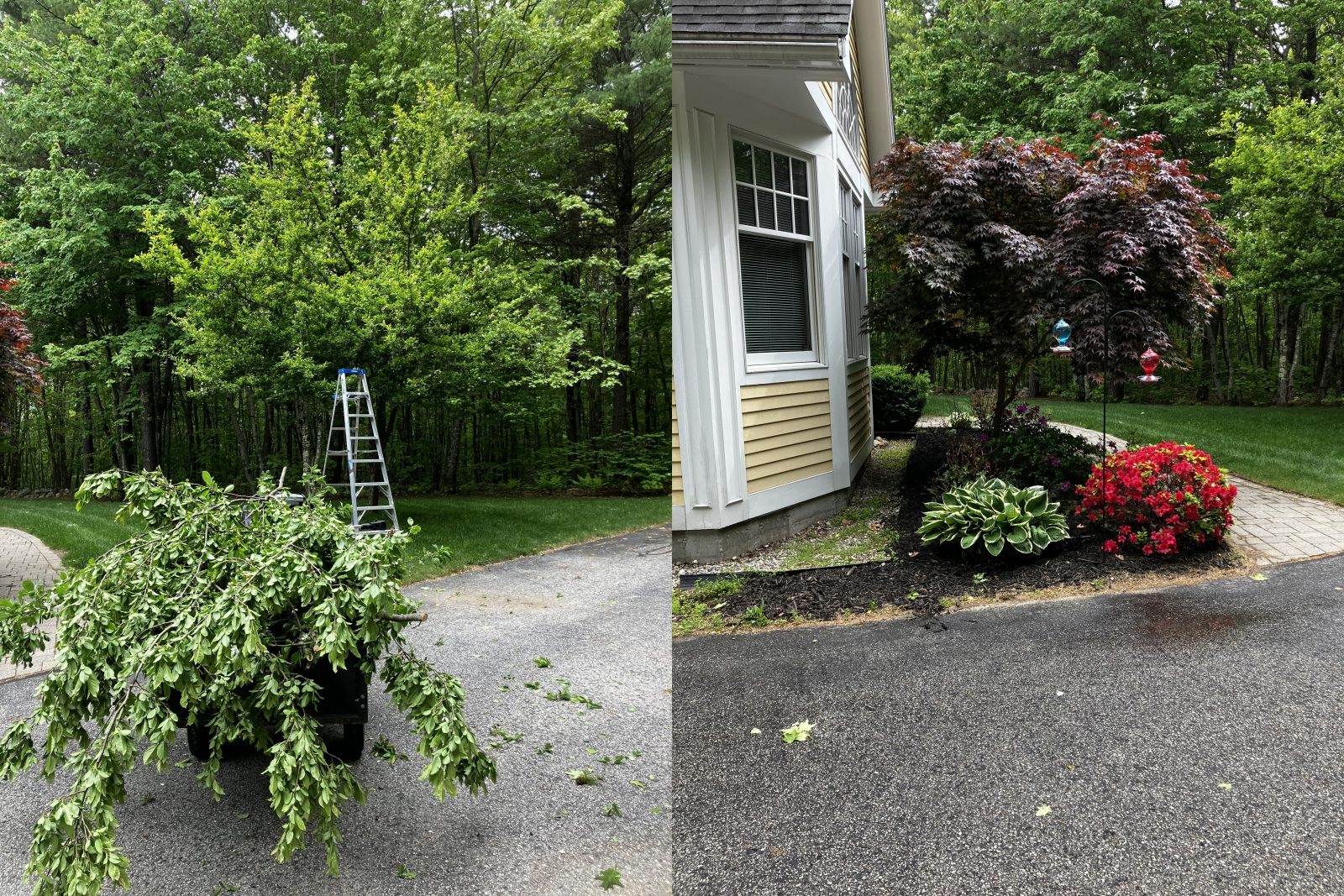
Why even pretend that getting caught up on spring projects is a reality? Fortunately these projects often require new tools and machines for completion. In this case, a powered pruner on a pole. The preexisting manual pole saw with integral pruner got caught in high branches with some frequency. Which required an interior tree assent, which often got me caught in high branches where the harsh realities of gravity brought the quick solution.
There is an existing powered pole saw in the landscaping arsenal, AKA chainsaw on a stick, but it is a tad too exuberant for finesse pruning. It once unintentionally rendered two beautiful flowering plumb trees into two stark and twisted tree stumps. The new pole mounted battery powered pruner is designed for more tactical, surgical strikes at unsuspecting branches. With the power pruner removed from the pole, it also removes low branches that could unceremoniously knock riders off of garden tractors. Theoretically speaking.
Lacking in formal topiary training, the crab apple tree that once proudly shot branches across driveway now has the trimmed appearance of a mullet with ears. The Japanese maple that once covered azaleas, hostas, several rose bushes, and the front walk now has the shape of a full on 1960s ‘fro. That’s OK. By summer they will have recovered, physically if not emotionally, and can then be more carefully trimmed.
Day dreams and great aspirations…
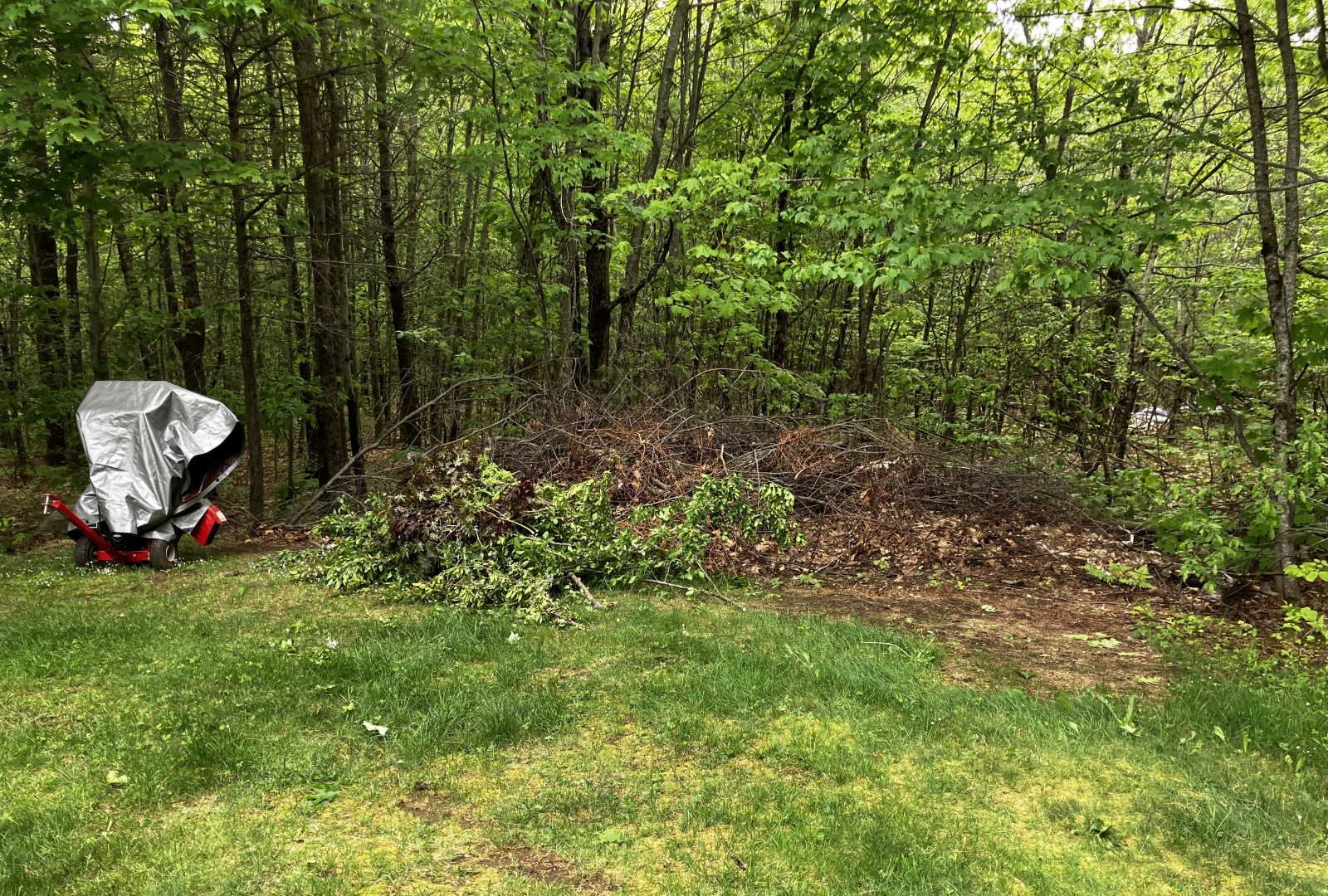
Since repair, the chipper has developed a voracious appetite for brush and branches. If the Kevlar catch bag hadn’t fallen into the hopper with the engine running, the chipper would not have been taken down to the last nut and bolt so that the flywheel could be machined and balanced and the cutters replaced. I am not sure if it will survive the daunting task that lies ahead. There is a retaining wall formed of boulders beneath where the pictured dead leaves begin, so the brush and tree pile drops three feet below lawn level and the pile goes back fifteen tick ridden feet. Since this picture was taken, two twenty-five foot oak trees have been piled on top. I live in a forest. I will never run out of trees.
Ordinarily I would rent a 50 HP drum chipper and clear the pile in a couple of hours, but the rental place raised their rates from $275 day to $50,000 – $60,000 per day… or something very close to those figures. Subsequently, big red will take out twigs and up to approximately three inches in diameter branches. Anything larger will be declared firewood and finished off with a chainsaw. The chips are being shot into a new compost pile, which happens to be located adjacent to the chipper’s discharge chute.
Flywheel chipper lessons I have learned. Do not leave a Kevlar collector bag atop an open hopper of a running chipper. Do not position a chipper on a steep downhill slope. Do not overload the feed. The cutters will take a big bite, stall the motor and leave an indigestible chuck of wood wedged against the flywheel. The next tug at the recoil started will result in the operator holding a broken piece of rope with a handle or succumbing to a dislocated shoulder. Just accept the chipper will have to be disassembled.
The Picasso of tail lights…
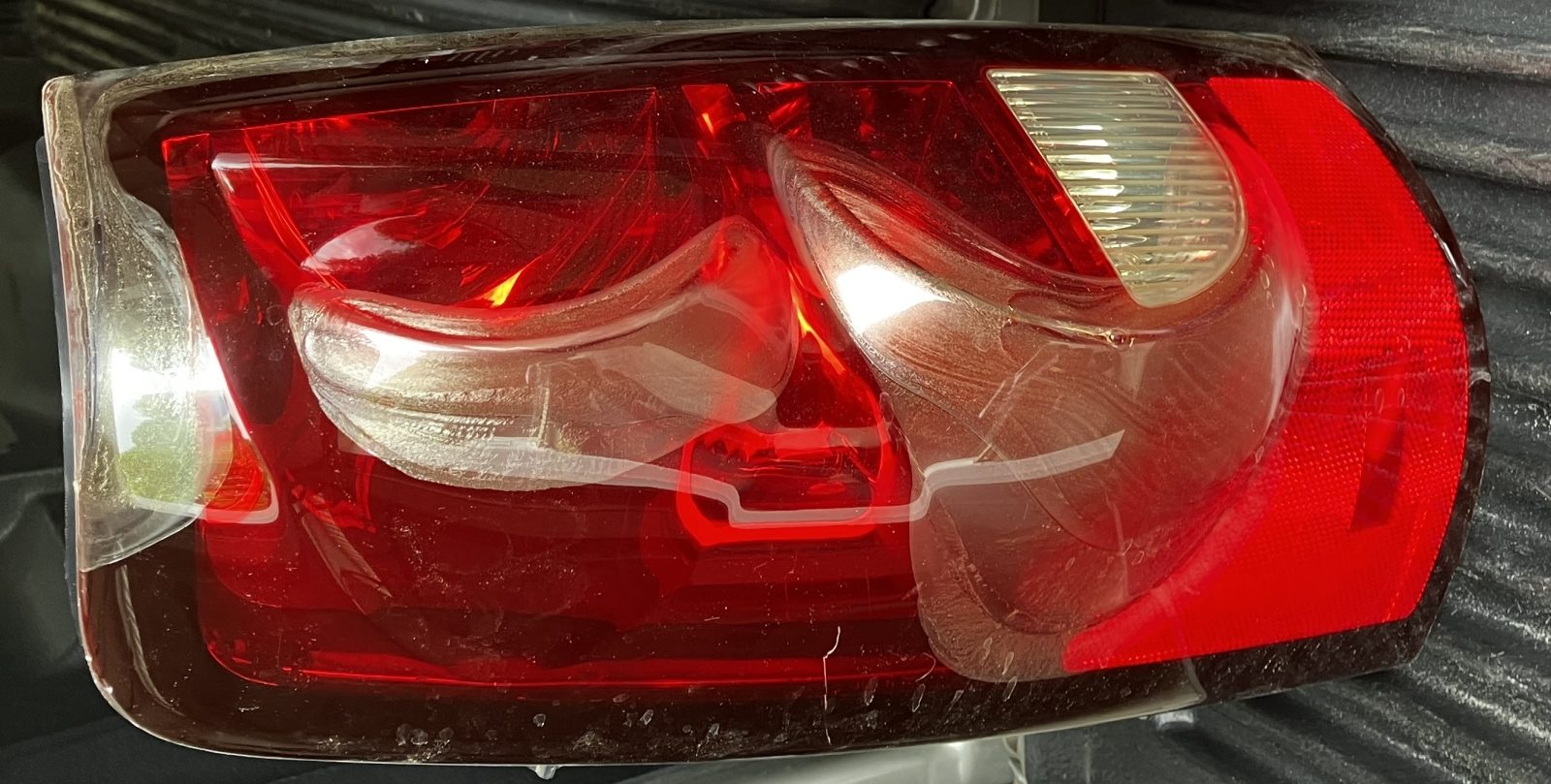
Chuck came down with a case of taillight delamination… about fourteen years ago. After fourteen years of procrastination, and a probable fail on this coming fall’s state vehicle inspection, it was time to make the repair. Chevy Silverado OEM tailights were priced at a good golly $532 and have since been discontinued. Replacements were purchased from Amazon for $46 for the pair, the product of highly automated production or incredibly cheap labor. At least we know what happened to all of the labor sneaker manufacturers laid off.
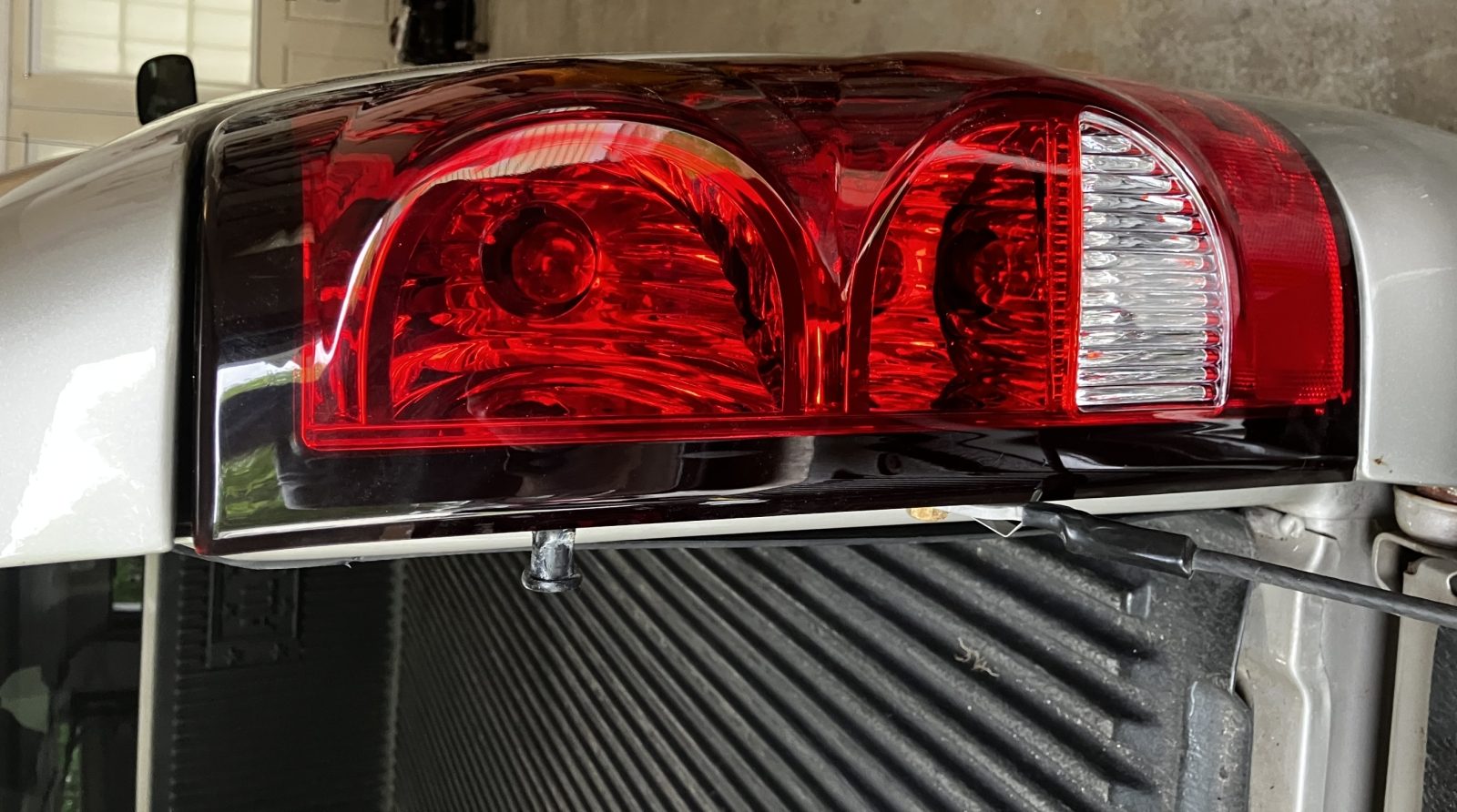
The replacement lights popped right into place, aligned with all of the mounting fasteners and even included new taillight harnesses. Chuck will no longer be embarrassed by an unsightly or unruly appearance and I can use the money I saved over GM parts for frivolous purchases, like food or gas, rather than on a GM executive bonus or their children’s Ivy League education.
Et tu, Sparky?
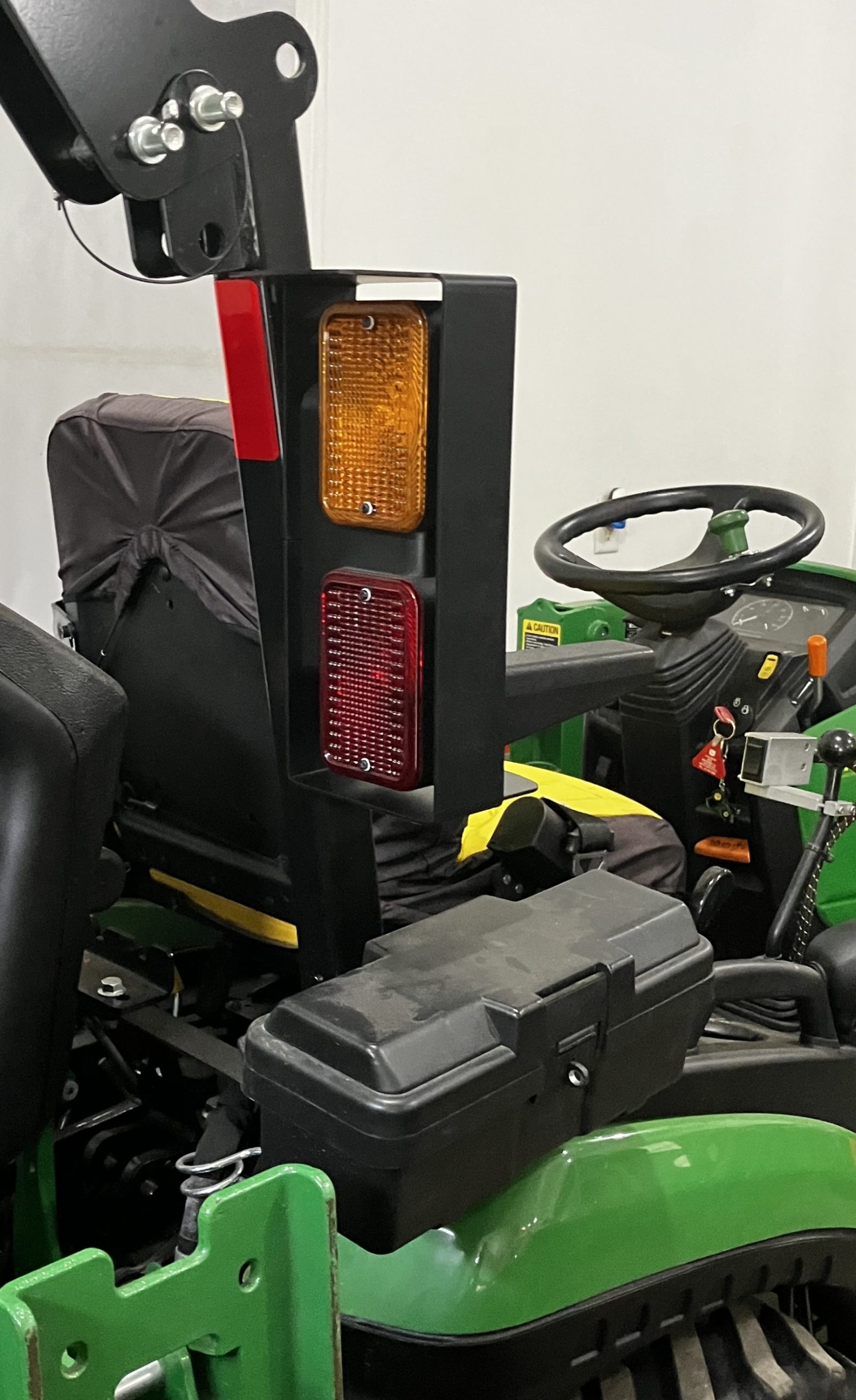
I had intended to install permanent rear work lights on Sparky but I only remember mid-winter with snow on the ground and a garage at -20°F. I’ve used clamp on lights with not great success as they were never wired correctly to work with the tractor’s light switch. So I bought a pair of brush guards for the hazard/brake light that have extended tabs top and bottom, specifically for the purpose of mounting additional work lights.
I also picked up a couple of spot/flood bright LED work lights in adjustable mounts that will fit properly on the brush guards for a clean look. There are already two 12 volt taps under the tractor’s seat, so I just have to find time to make up a couple of harnessed and the work light will sync to the hazard lights. Preferably before next winter.
Over time I have added a few accessories to Sparky which have proven to be useful. Hooks and D rings on the bucket, a mid step for climbing aboard, a steering wheel knob to make that 100 turns lock to lock manageable, and a seat cover to protect that perfect yellow and green John Deere seat. For winter, when snow clearing is often done in the dark, I picked up rechargeable rotating white/amber LED strobe lights that mount magnetically to the top of the roll bar. Oh yeah, I also replaced all of the headlights and work lights with 6500k LED bulbs, bright and daylight color temperature.
It’s a work in progress, but the tractor is a purchase I don’t regret. When cutting down trees the past couple of days, the tractor with grapple attached allowed me to move quite large pieces and hold them while I cut the larger diameters into firewood length. The backhoe has been used for digging out stumps and trenching for drainage and electrical conduit.
Bird chirps… Nature’s not that cruel
Close of day I was putting up tools when I heard a chirp. I often leave the garage doors open when working outside and occasionally some local wildlife will wander into the garage. The problem of animal removal is compounded by my hearing, or lack of the same. With one bad ear and one terrible, when I can hear it is hard for me to discern direction of origin, so I rely on visual cues if and when they present themselves.
I was wandering all over the garage, looking behind gear and boxes, under vehicles, up on shelves, when out pops this rotund little chick from a firewood pile with its feathers askew. It made no attempt to fly. It just kept hopping at the garage’s closed front pedestrian door, ignoring the wide open overhead door right next to it. So I put a hand down and showed him to the exit. Yes, I was the cooler.
A uniformly gray ball of fuzz, it hopped and chirped, hopped and chirped. No doubt a call for roadside assistance. Eventually, he (I assume it was a he because it was lost and refused to ask directions) hopped right into the middle of a puddle in the middle of the driveway , stopped hopping, but went into overdrive on chirping. In response an adult robin that is always foraging for food on an adjacent slope started hopping toward the chick. Do birds not fly anymore? When they were standing beak to beak, mom produced a worm and fed it to the chick then headed back to the slope. The chick remained, sitting in the pool of water, complaining. Kids!
Mom returned with another worm in its beak, but stopped at the edge of the puddle, squawking and shaking the worm in its beak. Eventually the chick realized it needed to exit the puddle if it wanted another worm, and so it did. It took mom about three worms to get the chick out of the puddle and into the safety of the overgrown ground cover. It was a nice afternoon show.





























No truer words than your subtitle Joe. Good luck with the never ending wood reconfiguration project.
Thanks, Scott. This timber harvest on the broader areas of the property has been motivating me to work more on landscaping and tree lines in closer to the house. Almost summer. Hope the year has been good for you and yours.